MIPS Assembly Sum Calculator
Project Overview
This project dives into the foundational layer of computing: Assembly Language. It is a program written for the MIPS architecture that performs statistical analysis on a stream of user-provided integers.
The goal is to calculate the Minimum Possible Sum and Maximum Possible Sum of a set of $N$ numbers by selectively excluding one element at a time. The challenge was to implement this logic efficiently at the register level, without the abstractions provided by high-level languages.
Multi-Language Support 🇮🇹 🇬🇧
The repository includes detailed documentation and logic explanation in both languages:
- English:
Project_eng.txt - Italian:
Project_ita.txt
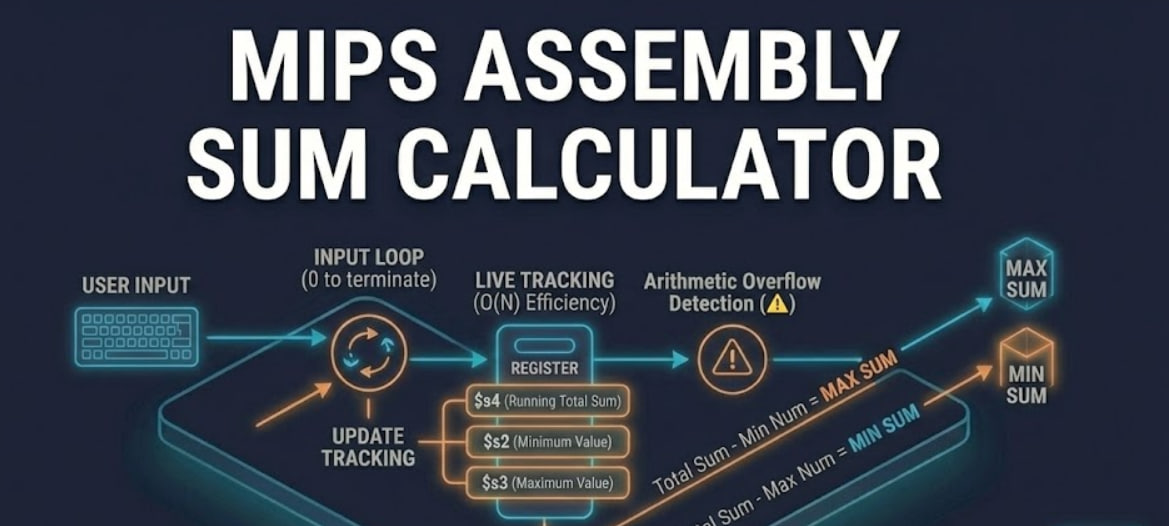
The Algorithm: $O(N)$ Efficiency
Instead of brute-forcing all possible combinations (which would be computationally expensive), the program implements an optimized mathematical logic during the input phase:
- Input Loop: Reads numbers one by one until
0is entered. - Live Tracking: While reading, it updates three registers in real-time:
$s4: The Running Total Sum.$s2: The Minimum value seen so far.$s3: The Maximum value seen so far.
- Final Calculation:
- Max Sum = Total Sum - Minimum Number.
- Min Sum = Total Sum - Maximum Number.
Technical Highlights
1. Manual Overflow Handling ⚠️
In high-level languages, large numbers are often handled automatically. In Assembly, I had to implement Arithmetic Overflow Detection.
The program checks the status flags after each addition. If the sum exceeds the 32-bit limit, the program safely halts execution and prints an error message ("The program has encountered overflow. END") to prevent data corruption.
2. Register Management
The code demonstrates strict adherence to MIPS conventions for register usage:
- Saved Registers (
$s0-$s4): Used for persistent data like Min/Max values and Total Sum. - Temporary Registers (
$t0-$t3): Used for volatile calculations and overflow checks.
Memory Layout
The program directly manipulates the specific memory segments of the MIPS architecture:
- Text Segment (
0x400100): Where the instructions reside. - Data Segment (
0x10011000): RAM allocation for storing user inputs and string literals.
Example Execution
Enter a number, 0 to start computation:
10
Enter a number, 0 to start computation:
5
Enter a number, 0 to start computation:
15
Enter a number, 0 to start computation:
0

The minimum sum is = 20 (Discarded: 15)
The maximum sum is = 25 (Discarded: 5)