Cross-out Puzzle Solver (ASP)
Project Overview
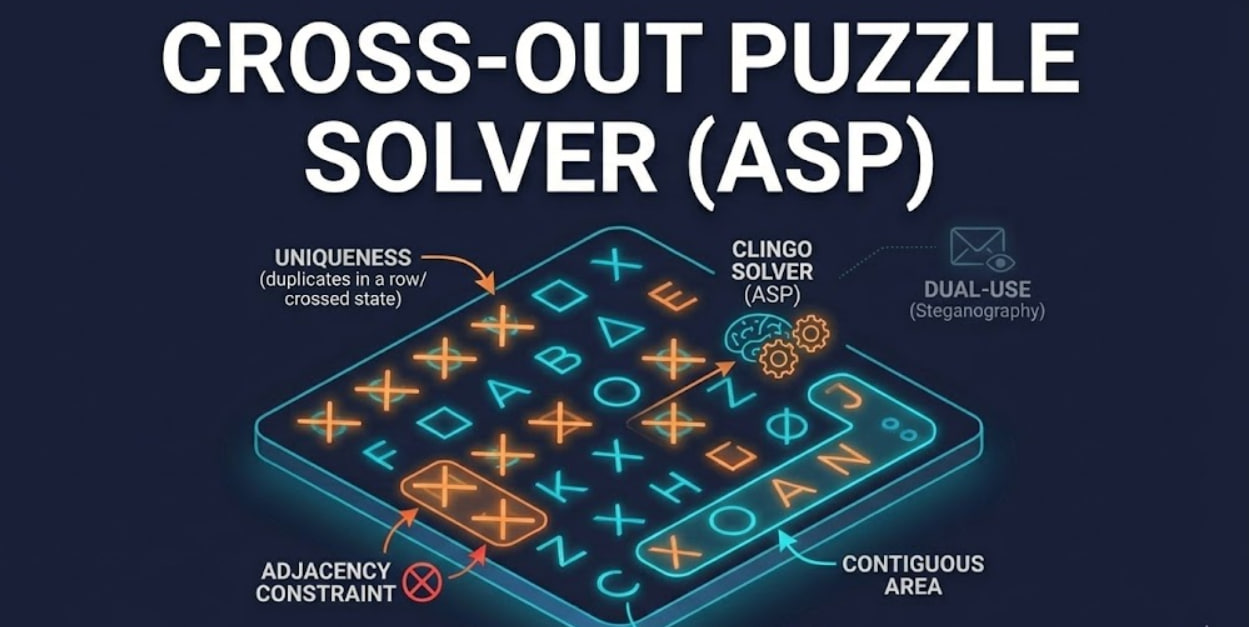
This project implements an intelligent agent capable of solving Cross-out Puzzles using Answer Set Programming (ASP). The challenge involves processing a rectangular grid of symbols and deciding which ones to “cross out” to satisfy strict topological and uniqueness constraints.
Beyond the code, the project explores the dual-use nature of AI algorithms, analyzing how a simple puzzle solver can be re-purposed for steganography or military defense strategies.
The Logic Model
The solver is implemented in Clingo and enforces three core rules:
- Uniqueness: No symbol can appear more than once in any row or column (unless crossed out).
- Adjacency Constraint: Two crossed-out symbols cannot be adjacent (horizontally or vertically).
- Contiguity: All remaining (kept) symbols must form a single contiguous area. This requires implementing reachability logic to prevent isolated islands of symbols.
Beyond Code: Ethical & Practical Applications
A unique feature of this project is the analysis of its potential real-world applications:
1. Steganography
The solver can be used to hide messages in plain sight.
- Concept: A public grid of symbols appears random or decorative.
- Hidden Channel: Only the receiver, knowing the specific constraint rules (the “key”), can filter out the noise (crossed-out symbols) to reveal the hidden message formed by the remaining characters.
2. Military Strategy (Minefield Safe Paths)
- Scenario: Modeling a minefield around a base.
- Application: The “contiguous area” constraint ensures that there is always a connected safe path for allied troops to traverse the grid, while the “adjacency constraint” ensures mines are spread out effectively to deter enemies who don’t know the safe route.
Tech Stack
- Language: ASP (Answer Set Programming)
- Solver: Clingo 5.7.1
- Reasoning: Constraint Satisfaction, Reachability Logic
Includes a dedicated report on the ethical implications of autonomous decision-making algorithms.